
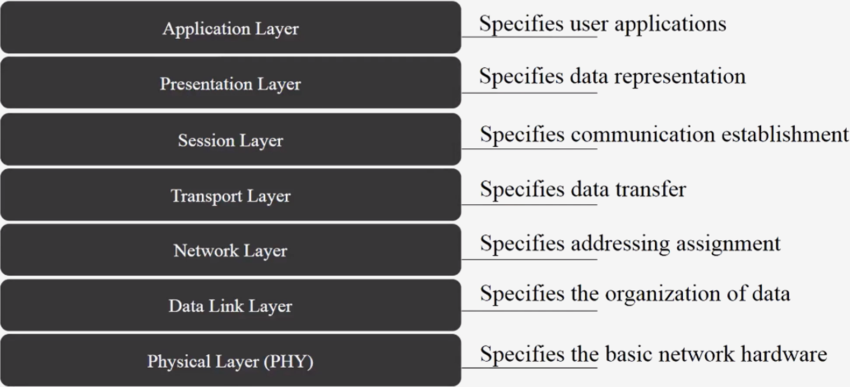
- OSI (Open Systems Interconnection) Model
- Layer Protocols
- Internet Protocol (IP)
- User Datagram Protocol (UDP)
- Transmission Control Protocol (TCP)
- Well-Known Port Numbers
OSI (Open Systems Interconnection) Model is a conceptual framework that standardizes the functions of a telecommunication or computing system into seven distinct layers. It serves as a universal language for computer networking, ensuring that different hardware and software from various vendors can communicate seamlessly.
The OSI 7-Layer Model
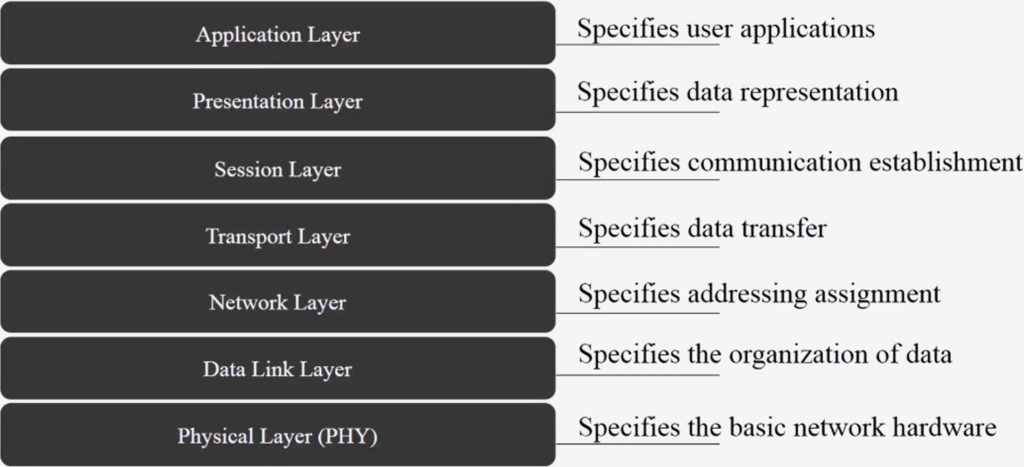
TCP/IP 5-Layer Model
The OSI 7-layer model got revised into the TCP/IP 5-layer model
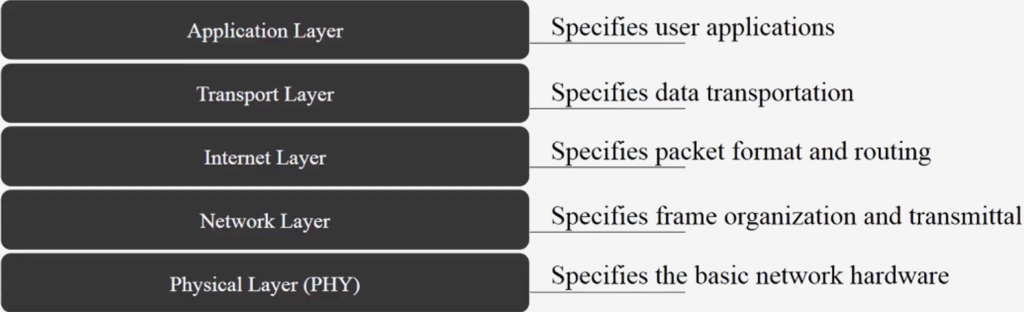
Common Accepted 4-Layer Model
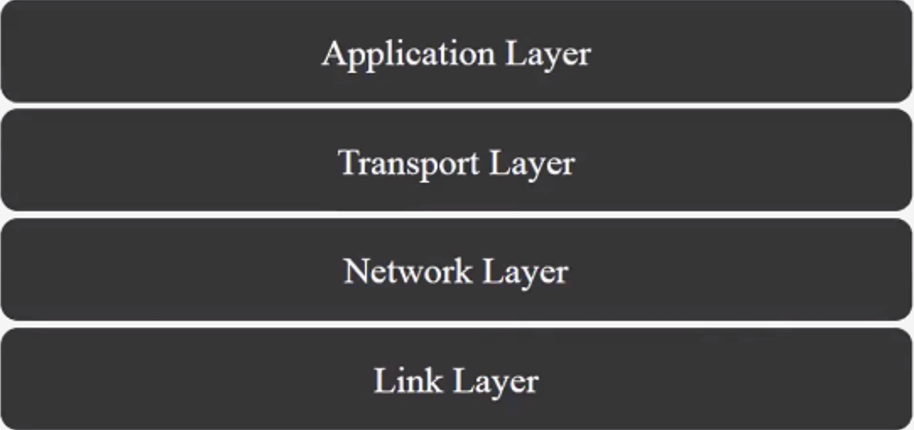
Link Layer: The main task of the link layer is to get packets across a single link. The link layer is responsible for connecting the host to its local network and moving data across a single link. Examples of link layer include cellular connection, like 4G or 5G, WiFi connection, Ethernet etc. The link layer deals with the hardware and, therefore, has an address that is assigned during the manufacturing of the hardware. This is a 48-bit serial number also known as the MAC address, e.g. 0F:2A:A2:1E:A1:19
Network Layer (Routing Layer): The main task of the network layer is to get packets across the network from source host to the destination host. This layer reads the header in each packet to see the destination of the packet and consults the routing tables in the router to see where to send the packet. This layer uses services of the link layer to send the packets. It does not guarantee the packets will arrive in correct order or even arrive at all.
Transport Layer: The main task of the transport layer is to reorder packets to provide reliability on top of the unreliable network layer. This layer is also responsible for retransmission and handling of congestion (TCP only). Essentially, while the network layer is concerned with routing packets to the right destinations host, the transport layer gets data to the right application running on the host. Two examples of transport layer protocols are TCP and UDP. Ensures data arrives safely at its destination. Segments and reassembles data into a data stream.
Application Layer: The link layer, network layer and transportation layer work together to reliably move data between two hosts across a network. Applications are then built to take advantage of this capability. Examples of applications include Skype, World Wide Web etc. Examples of application layer protocols include SMTP, HTTP, DNS, FTP etc. The application does not know and does not care how data gets from one host to another.
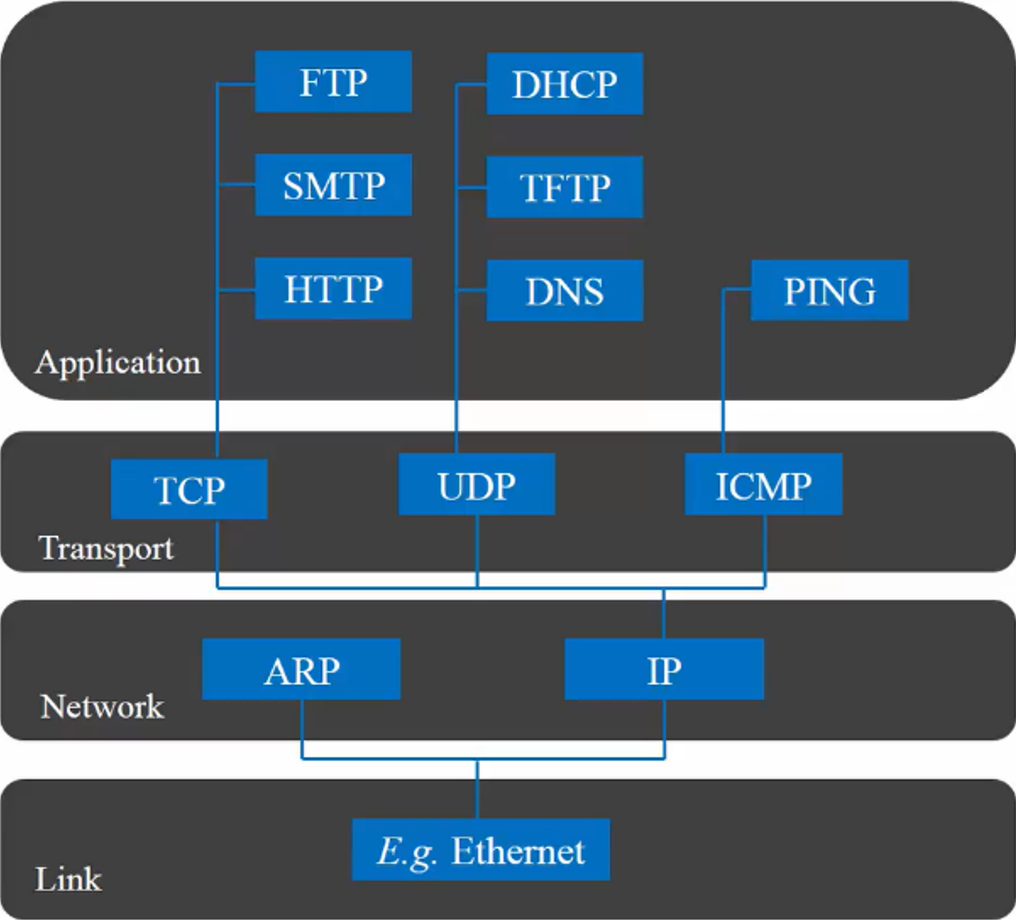
Layer Protocols
- FTP: File Transfer Protocol
- SMTP: Simple Mail Transfer Protocol
- HTTP: Hypertext Transfer Protocol
- DHCP: Dynamic Host Configuration Protocol
- TFTP: Trivial File Transfer Protocol
- DNS: Domain Name System
- PING: Utility for testing reachability of a host
- TCP: Transmission Control Protocol
- UDP: User Datagram Protocol
- ICMP: Internet Control Message Protocol
- ARP: File Address Resolution Protocol
- IP: Internet Protocol
Internet Protocol (IP)
The protocol provides communication between hosts of different kinds of networks. For instance, hosts may have different link layer implementation, one may be on WiFi and another may be on Ethernet. It is connectionless and its packets delivery is unreliable because there is no guarantee that the packets will be delivered. The IPv4 addresses consist of 4 numbers separated by dots, e.g. 192.168.0.50. Each of the numbers can be 0 to 255. The IPv6 addresses are longer, e.g. 2001:0ad8:62a1:0032:1000:7a1e:0250:5344. The IPv4 address can be broken into two parts. The first part is the Network Number (192.168), and the second part is the Host Identifier (0.50).
Netmask Address
Netmasks are used to identify which part of the address is the Network Number and which part is the Host Number. This is done by a logical bitwise-AND of the IP address and the netmask, e.g., 255.255.255.0.
User Datagram Protocol (UDP)
- This is the minimum service over the IP protocol
- This protocol is connectionless
- UDP is used by applications that need multicast or broadcast delivery
- UDP packets may be delivered incorrectly or may not be delivered
- UDP is optimized for sending packets to the destination as fast as possible
Transmission Control Protocol (TCP)
- It provides reliability
- This is a connection-oriented transport protocol
- TCP is optimized for accurate delivery, not fast delivery
- TCP can detect errors or lost data and trigger retransmission until data is received, complete, and without errors
Well-Known Port Numbers
| Service, Protocol, or Application | Port Number | TCP or UDP |
|---|---|---|
| FTP (File Transfer Protocol) | 20, 21 | TCP |
| SSH (Secure Shell Protocol) | 22 | TCP |
| Telnet | 23 | TCP |
| SMTP (Simple Mail Transfer Protocol) | 25 | TCP |
| DNS (Domain Name System) | 53 | UDP |
| TFTP | 69 | UDP |
| HTTP | 80 | TCP |
| POP3 | 110 | TCP |
| IMAP4 | 143 | TCP |
| HTTPS | 443 | TCP |
Back to top of the page